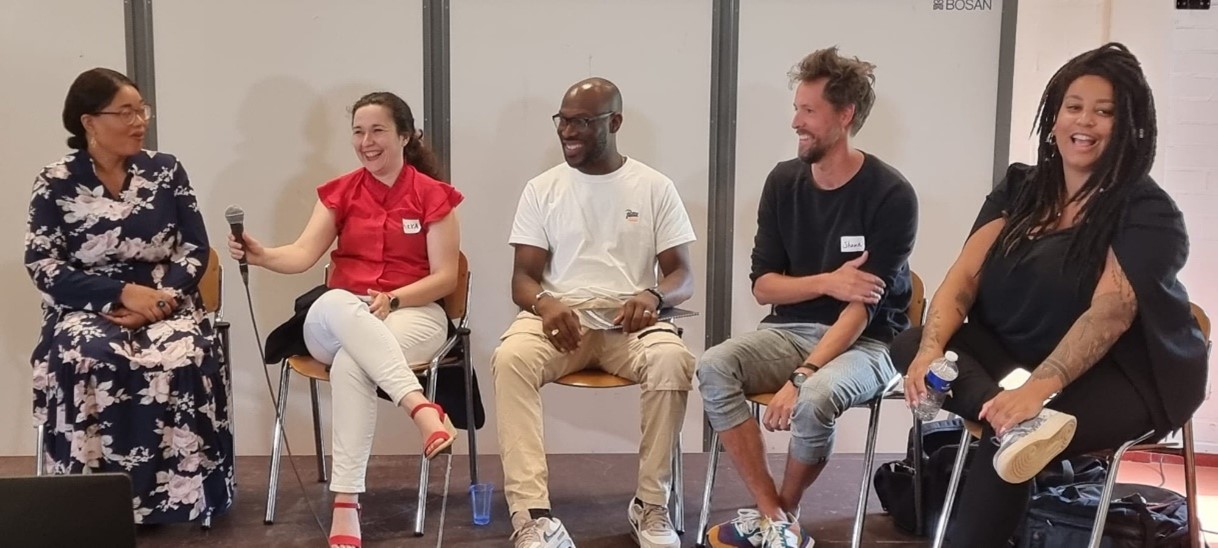
A huge thank you to everyone for their interest and for attending our event on 28 June at the Anansi community centre in Amsterdam South-East: Actions speak louder than words: the launch of the FYJAS Racism and Discrimination Quality Mark, sponsored by the MDRA and SWAZOOM. With around 40 participants in the end, we thoroughly enjoyed your enthusiasm and the warm welcome you gave to this new initiative aimed at systematically combating racism and discrimination within organisations. Please complete the contact form to keep up to date with news and developments relating to the quality mark. Below is a brief glimpse of the atmosphere at the event.
Take action and make an impact
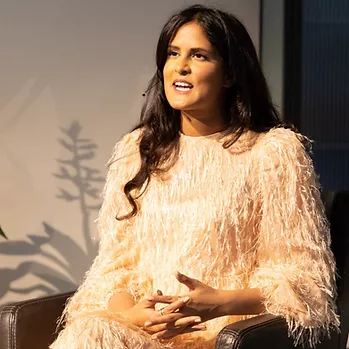
Raisa Ghazi, the moderator and host for the afternoon, aptly introduced the event:
‘There are many organisations that pledge to combat discrimination, but then fail to take action. It is harmful when organisations pretend to care about discrimination and racism whilst failing to take action. My hope for the new quality mark is that it will make an IMPACT, so that we can all fulfil our potential..’
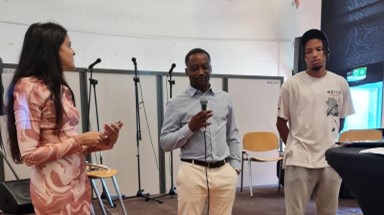
Andwele Slory and Tyronne Ebuehi share their personal stories
The FYJAS quality mark came about when CEO Marjorie Esajas’s son faced discrimination during his career as a professional footballer. The afternoon began with his personal story and that of professional footballer Tyronne Ebuehi. Andwele, who now works as a player development coach, explains that it is important to make a stand: ‘If it happens again, I’ll walk off the pitch’. Tyronne also faces a great deal of racism on the pitch and hopes that racism will be a thing of the past in the future. ‘It’s important that people know what it does to someone. Not just in football, but in everyday life too.’
Spoken word artist Fleksick (Shaneegua Flechsig)
“Going back in time, in control of your own body”
~Fleksick
Black with red blood and a blue glow
The wounds are purple
”Where are you from?"
Fleksick struck a chord with her beautiful spoken word piece about living with mixed heritage in the Netherlands. You can follow her on Instagram at @fleksick, and hopefully we’ll see her back on many stages!
Malcolm Jones, councillor for the Party for the Animals in Leiden
Malcolm spoke about inclusive communities. ‘You can think of a more inclusive community as a rough diamond. If you don’t put in the effort, it won’t sparkle. But if you do take the trouble to cut it, you’ll get that beautiful sparkle that everyone longs for. Malcolm is positive about the FYJAS quality mark: it’s an important step in the right direction. It means we’ll soon be able to enjoy a higher standard of quality. Because not everyone reaches the top; it’s an extra struggle if you’re different.’
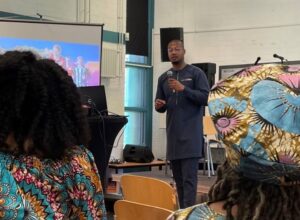
Sarah Elbadr-Boers, Project Lead for Amsterdam Diverse & Inclusive
Sarah was unfortunately absent due to illness. Fortunately, Jerrol Marten delivered her speech. Sarah emphasised that if it is merely an empty quality mark, it is of no use to anyone; people see right through it. But if it is a quality mark with substance – involving assessment and accountability – and, as a result, they genuinely become a better and discrimination-free employer? Then that has several advantages for them:
- They will attract more applicants, which is very important in this tight labour market.
- People who are taken on are more likely to stay, because if genuine efforts are made to create a safe working environment for everyone, they will want to stay rather than being driven out or resigning because the working atmosphere is unsafe.
- You’re setting a standard: this is who I am as an employer. That doesn’t mean, incidentally, that everything will go perfectly straight away; in fact, there may well be more reports of inappropriate behaviour or discrimination, particularly at the start. But more reports aren’t always a bad thing. What we often see, in fact, is that companies which want to pay more attention to diversity also bring more issues to light. The problems were always there; it’s just that people are only now daring to speak out. So more reports can also be a good sign. It means that we’re finally, finally heading in the right direction.
Jerrol Marten, Director of the Amsterdam Region Discrimination Helpline
Jerrol explains that the quality mark sets an important standard that helps to eradicate discrimination and racism: ‘That’s what I miss now. No standards are being set; anything goes under the guise of satire. The quality mark points us back in the right direction.” Jerrol summarises the recent study into labour market discrimination carried out by the Meldpunt: as many as 70 per cent of Amsterdam-based companies do not respond adequately to discrimination in the workplace. Companies downplay complaints about discrimination or dismiss a discriminatory remark as a joke. For the study, the Meldpunt analysed 125 cases from 2018, 2019 and 2020. Charters and similar initiatives all rely on goodwill; there’s no stick to enforce them. The FYJAS Racism and Discrimination Quality Mark does provide that.’
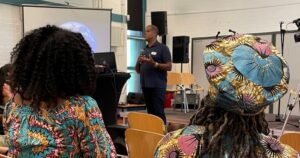
Angelo Birjmohun, youth coach and marketer
Angelo shares his story about an internship at a renowned company where he was systematically subjected to discrimination and exclusion. The organisation was predominantly white, and there was a certain culture where nobody dared to speak out. Angelo found his own way forward by focusing on things he could influence himself. Such as challenging the stereotypes that assume you’ll turn up late or fail to finish your work on time. Angelo: ‘I wish I’d had a coach back then, just as I am one for others now. So this is probably how it was meant to be.’
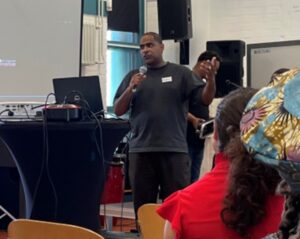
Marjorie Esajas, CEO of FYJAS
Marjorie This ties in with the title of the event: ‘It’s no coincidence that this day is called ‘Actions, not words’. We keep waiting for the genie to come out of the bottle again, so that everyone can have another chat about discrimination and racism. But we need to tackle this problem proactively so that it can be prevented. The quality mark is a huge help in this regard. It holds organisations and associations accountable for providing a safe environment and an effective anti-discrimination policy.’
Marjorie’s dream is for the quality mark to become mandatory nationwide and to be implemented by all private and public organisations, including those in the sports sector, throughout the Netherlands. She invites anyone who is interested, would like more information, or would like to help make the quality mark a success to get in touch. You can do this by fill in the contact form or email us at info@fyjas.nl.
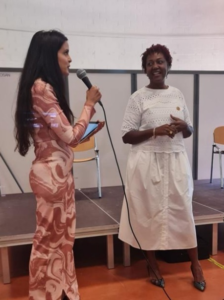
Mitchell Esajas, co-founder of New Urban Collective and The Black Archives
Mitchell explains that, in the wake of the Black Lives Matter protests, many organisations posted a black square on social media as a sign of support. ‘But if you were to assess, a year on, what organisations have actually done to combat racism during that year, you would probably find that the majority have merely made symbolic gestures.’ That is why Mitchell considers the quality mark so important. ‘It is a concrete means of combating discrimination.’
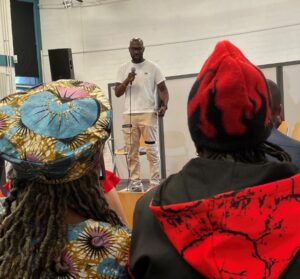
Audience panel
We rounded off the day with an enthusiastic audience panel, during which members of the audience took part in a panel discussion. The panel consisted of:
- Vayhishta Miskin (Member of the Executive Committee of Amsterdam Zuidoost)
- Mirka Antolovic (Director of Tumba)
- Mitchell Esajas (Co-founder of New Urban Collective and The Black Archives)
- Shaun Voogd (co-owner and Creative Director at FILMMACHT)
- Sacha Martina (Founder & CEO of Your Talent Agency)
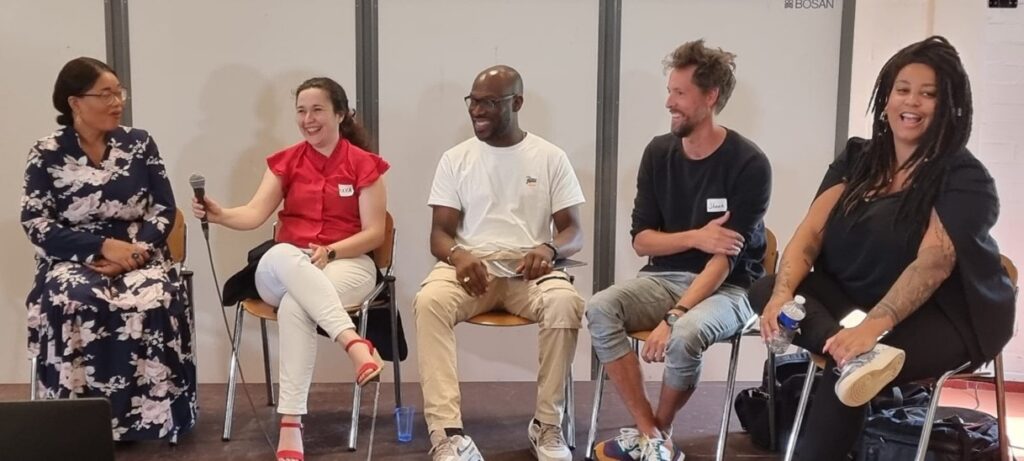
Sacha says: ‘This is the the icing on the cake ’It’s something that’s been needed for a very long time. I constantly have to explain that I’m the CEO of my company, because I don’t fit the stereotypical image of a CEO.‘ Vayhistha explains that, as a mother of two, she doesn’t want her children to experience the same pain, sadness and helplessness. ’If only this had been around when I was young – it’s absolutely brilliant that it’s here now.’ Shaun would like to contribute ideas on how the quality mark can be promoted further. Mitchell picks up on this: starting small can ultimately have a big impact, if people share information within their networks. Mirka: anti-discrimination services can also help promote the quality mark by offering it as a solution to the organisations we speak to. Vayhistha is also keen to contribute ideas on raising awareness of the quality mark in her role on the Executive Committee at Amsterdam Zuidoost.
Thank you to all the speakers and panellists for a fantastic day. Here’s to a future in which the FYJAS Racism and Discrimination Quality Mark has become an integral part of our society!
Actions speak louder than words!