



This column was written by: Susana Filgueiras & Marissa Shanmugalingam
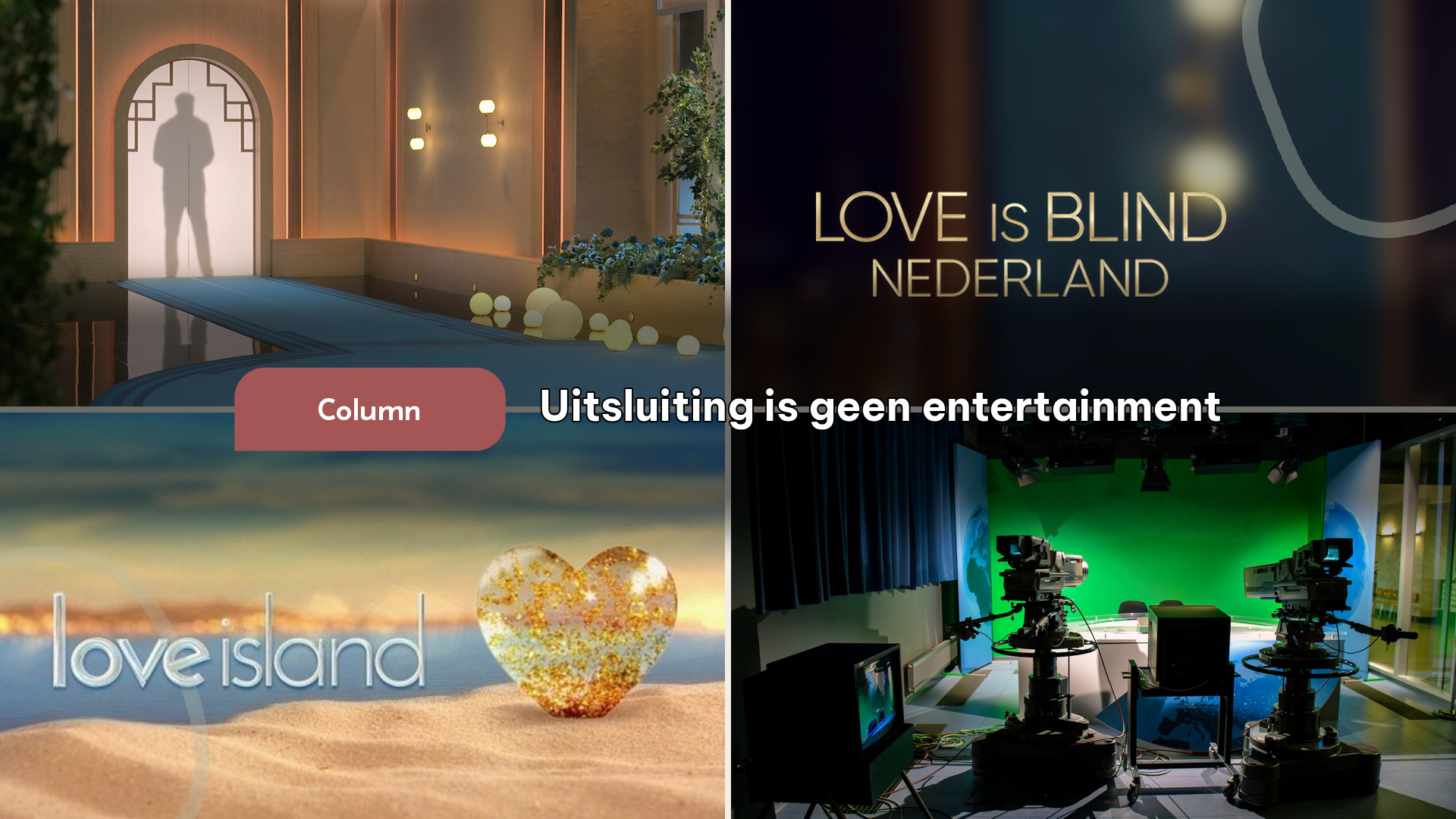
The Dutch media landscape has gained another dating programme: Love is Blind Netherlands.
A scene from the first episode goes viral, because a group of people appears to be excluded on the basis of their skin colour. The focus is mainly on the participants, but the issue of discrimination in the public debate is broader and multi-layered: what impact do similar scenes from reality TV have on public perception, and to what extent are they deliberately used to boost viewing figures and commitment to draw, and what responsibility do programme-makers have in this regard?
The media are not neutral: the way in which groups are portrayed can reinforce existing stereotypes, but can also help to break them down. Research into media representation shows, for example, that repeated negative or stereotypical portrayals can influence the way in which minority groups are perceived by others and by themselves having regard to[1]. This can start as early as making off-the-cuff remarks such as “…but you sound like a Dutch person”. These subtle, often recurring remarks are also known as microaggressions. When people are regularly subjected to them, these remarks can reinforce feelings of exclusion and perpetuate existing stereotypes[2].
Such stereotyping is not confined to any one community. For example, women of East Asian descent are regularly portrayed in the media as hypersexual and exotic. These stereotypes reduce them to a distorted image of who they are and can contribute to perpetuating prejudices in society[3]. In addition to these stereotypes, skin colour itself also plays a role in the way people are represented and valued. Within communities of colour, colourism prejudice: a form of discrimination in which people are treated differently on the basis of their skin colour, with lighter skin often being held in higher social regard than darker skin.
In the media, this is reflected, for example, in the beauty ideals that are promoted, the people who are cast, and the romantic preferences that are highlighted. In the programme Love Island, we often see that participants with darker skin tones are frequently chosen last. Research shows that these preferences are linked to broader historical and social power dynamics[4]. This is particularly evident in dating programmes and reality TV. When participants are paired up based on who they find attractive or with whom they would like to enter into a relationship, it sometimes seems as though such preferences stem solely from individual choices, without any external influence. In reality, our ideas about attractiveness and relationships are partly shaped by the social attitudes, representations and beauty standards we are exposed to over the years. There are also further consequences for participants and viewers who are under-represented or portrayed negatively in relation to Eurocentric beauty standards: for example, this can contribute to lower self-esteem amongst people who do not conform to the norm[5].
That is why programme-makers must become aware of their responsibility and actually take it on. Simply casting participants from different backgrounds and of different skin colours is not enough. Certainly not when sensitive interactions relating to ethnicity are used to boost viewing figures, without allowing space for reflection. That is why questions such as how participants are edited, which interactions and conflicts are highlighted and emphasised, and what context is provided are central to programme-makers actually taking responsibility.
But we don’t just see a problem; we also see an opportunity to do better.
We call on the creators of Love Is Blind Netherlands Encourage participants to reflect critically on the choices surrounding similar scenes. Engage with participants in a discussion about their experiences of racism, assumptions, stereotyping and colourism. Give space to their perspectives and arrange aftercare if participants have become the subject of public discussion as a result of this programme component.
As a programme maker, you should also take a critical look at the role of editing and promotion. Whether consciously or unconsciously, we use certain assumptions and stereotypes to help us understand the complex world around us. That does not automatically make us bad people. The key difference lies primarily in what we ultimately do with them. Whenever assumptions, stereotyping or power dynamics come into play, choose to provide more context, support those involved, create space for reflection, speak out as a production team and take action.
Participants can then still be portrayed fully and authentically: people who make mistakes can learn and see different sides of a situation can highlight. Here, too, lies an opportunity – not to shy away from difficult conversations, but to turn them into learning opportunities. This helps viewers to reduce stereotyping by thinking more critically about the messages they receive through the media.
Our core message is therefore simple: No form of discrimination is entertainment. As soon as programme-makers incorporate social issues into their content, they also bear a responsibility to address them in a critical and careful manner, without reinforcing existing prejudices or undermining their impact. The reluctance to discuss racism in a substantive and socially responsible manner is a key part of the problem. We believe there’s a better way. Do better next time.
[1] Council of Europe, Media and discrimination: The role of the media in shaping attitudes and perceptions.
[2] Sue et al. (2007), Racial Microaggressions in Everyday Life: Implications for Clinical Practice, *American Psychologist*
[3] Takken, W. (30 October 2022). From Mr Cheung to Ushi: when television tells you that you’re not really Dutch. NRC. https://www.nrc.nl/nieuws/2022/10/30/van-meneer-cheung-tot-ushi-als-tv-je-vertelt-dat-je-er-niet-echt-bij-hoort-a4146717
[4] Hunter (2005), Race, Gender, and the Politics of Skin Tone, Routledge
[5] Grabe, Ward & Hyde (2008), The Role of the Media in Body Image Concerns Among Women: A Meta-Analysis of Experimental and Correlational Studies, Psychological Bulletin